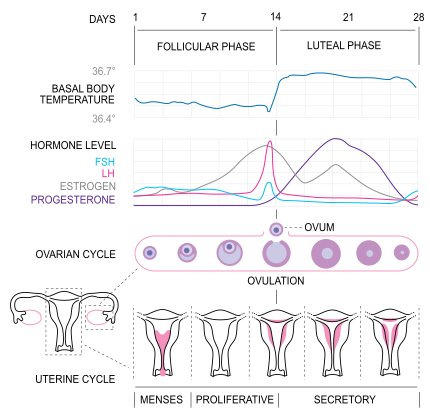
Of the three fertility signs (the others being cervical fluid and cervical position), this one amazed me the most and I think as a starting point it's pretty simple to initiate. Basically, the second you wake up, you take your temperature. I don't even have to look at the result, I can just sleep merrily on, because it shows me the next time I turn it on.
The magic is that waking temperature rises higher by about a tenth of a degree after ovulation occurs. Note this is after ovulation, so for the sake of not getting pregnant this is a bit of a late sign. The temperature stays high, as I described in the last FAM post, because of the progesterone released by the yellow body (corpus luteum). As the yellow body disintegrates, if the egg is not fertilized, progesterone diminishes and menstruation starts, beginning the cycle again and temperatures come back down.
Like I've also mentioned before, this luteal phase spans a finite amount of time, between 12 and 16 days. So, by knowing when ovulation probably occurred by looking at ones charts, one can predict just about when menstruation will start. This can be very convenient!
It's also important to note that there are ups and downs in the day to day temperatures, but only in looking at the general trend can you see the tendency for lower temperatures in the follicular phase (before ovulation) and the tendency for higher temperature in the luteal phase (after ovulation). To get technical about it, in Celsius, temperatures in the follicular phase are about 36.1 to 36.3; and in the luteal phase about 36.4 to 36.6. Pretty minute changes, but noticeable and certainly chartable.
Tips from TCOYF:
1. take your temp first thing upon awakening, before any other activity (including, drinking water and going to the bathroom)
2. take it about the same time every morning, give or take an hour
3. use a digital thermometer, until it beeps
4. take your temperature orally and be consistent about it.
You can find plenty of charts on the TCOYF website here. And you're set to get started!
Tuesday, October 25, 2011
Irene Klar
| Twilight Patterns |
| Precious Bundles |
| Woman of Canyon Del Muerto |
Saturday, October 22, 2011
Soba Noodle Salad
My sister makes very tasty soba noodle salad and trying to copy her, I made one based on the Moosewood Restaurant Cooks at Home cookbook. Not as tasty as hers, but it will have to do! I would definitely make it again because it is so simple.
a few big handfuls of baby spinach
2/3 cup of chopped scallions
1/2 block of extra firm tofu, cut into small cubes
1 package of soba noodles
- 1 Tbs brown miso paste
- 1/3 cup of hot water
- 2 Tbs of apple juice
- 2 Tbs of sesame oil
- 1/4 cup of tamari or soy sauce
- 1 Tbs of finely grated fresh ginger
- 2 Tbs rice vinegar
Sesame seeds as topping (optional)
Bring a large covered pot of water to a rapid boil. Cook the noodles until just tender, about 3 minutes. Drain, rinse under cold water, and drain again.
While the pasta cooks, prepare the sauce: In a small bowl, dissolve the miso in the water. Whisk in the apple juice, sesame oil, soy sauce, ginger, and vinegar. Chop the scallions.
In a serving bowl, toss the baby spinach, tofu, scallions, and sauce with the noodles. I put the spinach in first to allow it to wilt a bit with the warm noodles. Sprinkle with sesame seeds right before serving.
Serve warm or cooled.
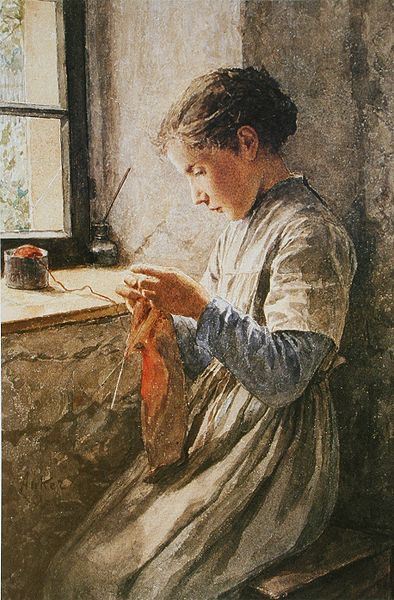
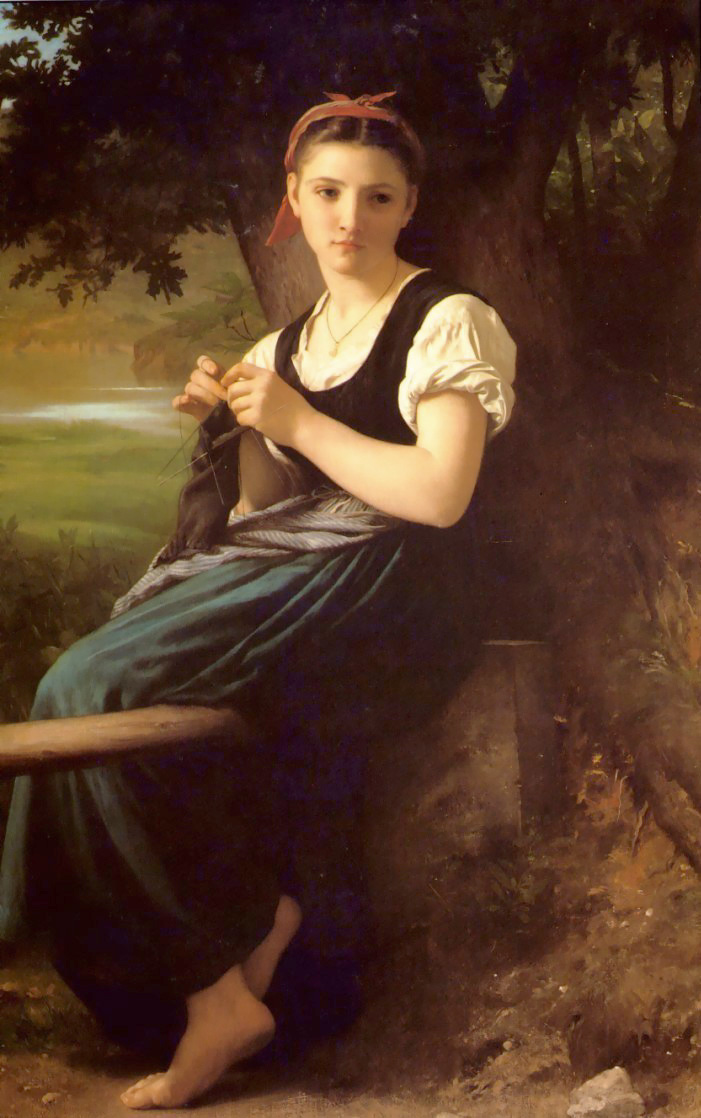
Knitting in paintings
| Paul Cézanne |
| Albert Anker: Strickendes Mädchen vor Fensternische |
| Dutch Painting in the 19th Century - Haverman - The Knitting-Lesson |
| Tricoteuse paintings by William-Adolphe Bouguereau |
| Jean-François Millet - The Knitting Lesson |
I was pleased to note the number of paintings that come up with women, particularly girls, knitting, because I'm sometimes told, "well, aren't you a little too young to be knitting?"
All photos are from Wikipedia
Knitting, the Yarn Swift and the Ball Winder
With the quickly changing season, I have become completely engrossed in my knitting. I am making, for the first time, a throw blanket. All in one piece, I'm making it on an 80cm round needle to hold all 137 stitches. You can see how my hands have been quite tied up! If found the pattern on Knitty (website here, pattern here). I think it might turn out to be the biggest thing I've ever made and I'm getting a callous on my pointer finger on my right hand to show it. I'm about 2/3rds done. Of course, mine does not look anything like the picture because I'm using up a few different balls of colour and I haven't blocked it yet. Blocking is when you wet a finished knit, stretch it and pin it down till it dries to the exact shape/size you wanted. But I suspect I will run into trouble there because of my strange left-handed (despite being right-handed) knitting.
In other exciting news, my weekly knitting group has started. We had a pretty fun time last week with a swift (the thing that resembles a miniature clothes drying rack) and a ball winder (that looks like a defunct blow dryer). Both parts are used to turn a newly bought hank (twisted yarn) into a ball. I learned a great deal in the last five minutes in trying to write that last sentence. I also came across some rather nice pictures of swifts, seen below.
Of course, the reason you use the swift with the hanks (and not balls or skeins) is because the hanks untwist in a large circle that fits just right around the swift, and this spins around to feed into either a manually made ball or the ball winder. But it's not a big deal to feed a skein or a ball of yarn directly into the ball winder to make a lovely ball of yarn that is not too tight and allows one to grab yarn either from the center or from the outside (e.g. when doubling the yarn to make it a thicker gauge).
The Ball winder looks a bit like this, where yarn is fed through the little metal extension to the left onto the spindle. Then you manually crank it. It was declared by some that this would be a wondrous lifetime career while others noted the boredom that would quickly ensue...
And voilà!
In other exciting news, my weekly knitting group has started. We had a pretty fun time last week with a swift (the thing that resembles a miniature clothes drying rack) and a ball winder (that looks like a defunct blow dryer). Both parts are used to turn a newly bought hank (twisted yarn) into a ball. I learned a great deal in the last five minutes in trying to write that last sentence. I also came across some rather nice pictures of swifts, seen below.
The Ball winder looks a bit like this, where yarn is fed through the little metal extension to the left onto the spindle. Then you manually crank it. It was declared by some that this would be a wondrous lifetime career while others noted the boredom that would quickly ensue...
And voilà!
Monday, September 26, 2011
cà phê sữa
This one is for my Mum.
How To Make Vietnamese Coffee from High Beam Media on Vimeo .
by Eric Slatkin
via Life: The Atlantic
Reclaiming the F Word
The New Feminist Movement
by Catherine Redfern and Kristin Aune
Sometimes I argue with a few people whether feminism is the right word to use anymore. By continuing to call myself a feminist, does this only further the confusion around what that really means? For me, it used to elicit images of the mother in Mary Poppins, while Mary Poppins cared for her children Mrs. Banks (Glynis Johns) rallied for the vote for women.
But that's certainly not entirely what it means, is it?
I picked up this book for the shelf of the Northern District Toronto Public library (my current favourite for content) a bit by happenstance. It had a curious cover and the titled rubbed me the right way, right away.
"I'm not a feminist, but..."
Redfern and Aune start by pointing out that despite claims that either feminism is dead or the other extreme that feminism has gone way over-the-top, most people do align with feminist values, it's just that they don't call it like it is. They consider that "rather than thinking that feminism has failed because 'only' 25% of women are feminists, we need to keep in mind that being an active feminist was never a popular choice, even in the 1970s. And 25% is a very good support base for a social movement."Furthermore, the methods might be a bit different now to show one's feminist stripes.
So why do people shy away from the word feminism? Redfern and Aune speculated that some may not consider themselves "active" enough to take on the label, while others are men who avoid it on the basis of their sex. Some may also associate it with a particular feminist that they did not like or thought that it predominated with white, middle-class women's issues. Really, it seems obvious that the problem is in the definition of feminism.
Is feminism no longer needed?
No. Certainly things have come a long way in terms of women's rights, precisely as a result of earlier feminist movements, but there remains a lot to do! As Redfern and Aune say, "women's visibility in popular culture doesn't mean women are valued, safe from violence or equal."And later in the book, "Women are still being raped, paid less than men, and access to abortion is restricted."
Defining Feminism
Through this book, Redfern and Aune sought just that, to identify what feminism is up to today. Perhaps one of the biggest challenges in feminism today is the "how"and "what" of equality, and debates certainly rage even among feminists over issues like pornography, the sex industry and men's role in feminism. As a disclaimer, Redfern and Aune note, "Not everyone will agree on the issues we've highlighted, and everyone will prioritise them in different ways. Even if you are a feminist, you certainly won't agree with everything you read here." But is that not part of feminism? Challenging the norm and embodying different beliefs in an open debate. In seeking to be liberated from oppression, it would be quite silly for feminists to then oppress others.

Feminism is...
... an individual survival mechanism: "It assures that you have the right to live your life the way you want and imagine a brighter future for the world. It prompts you to question the status quo, rather than assuming that the way things are is the best they can be."
... collective action: "Feminism assures you that you're not alone, that the problems you experience are shared by others, and that, as a woman or a gender non-conforming person, your concerns are important." and "Feminism provides you with a support network for your interests and campaigns. It enables us to band together on issues we agree on."
... collective impact: "Feminism encourages us to consider the wider impact of our actions. In other words, it's not just about us, but is about ending sexism and liberating everyone from centuries of oppression based on gender."
Chapters
1. Liberated bodies
2. Sexual freedom and choice
3. An end to violence against women
4. Equality at work and home
5. Politics and religion transformed
6. Popular culture free from sexism
7. Feminism
by Catherine Redfern and Kristin Aune
Sometimes I argue with a few people whether feminism is the right word to use anymore. By continuing to call myself a feminist, does this only further the confusion around what that really means? For me, it used to elicit images of the mother in Mary Poppins, while Mary Poppins cared for her children Mrs. Banks (Glynis Johns) rallied for the vote for women.
But that's certainly not entirely what it means, is it?
| From the book's website here |
I picked up this book for the shelf of the Northern District Toronto Public library (my current favourite for content) a bit by happenstance. It had a curious cover and the titled rubbed me the right way, right away.
"I'm not a feminist, but..."
Redfern and Aune start by pointing out that despite claims that either feminism is dead or the other extreme that feminism has gone way over-the-top, most people do align with feminist values, it's just that they don't call it like it is. They consider that "rather than thinking that feminism has failed because 'only' 25% of women are feminists, we need to keep in mind that being an active feminist was never a popular choice, even in the 1970s. And 25% is a very good support base for a social movement."Furthermore, the methods might be a bit different now to show one's feminist stripes.
So why do people shy away from the word feminism? Redfern and Aune speculated that some may not consider themselves "active" enough to take on the label, while others are men who avoid it on the basis of their sex. Some may also associate it with a particular feminist that they did not like or thought that it predominated with white, middle-class women's issues. Really, it seems obvious that the problem is in the definition of feminism.
Is feminism no longer needed?
No. Certainly things have come a long way in terms of women's rights, precisely as a result of earlier feminist movements, but there remains a lot to do! As Redfern and Aune say, "women's visibility in popular culture doesn't mean women are valued, safe from violence or equal."And later in the book, "Women are still being raped, paid less than men, and access to abortion is restricted."
Defining Feminism
Through this book, Redfern and Aune sought just that, to identify what feminism is up to today. Perhaps one of the biggest challenges in feminism today is the "how"and "what" of equality, and debates certainly rage even among feminists over issues like pornography, the sex industry and men's role in feminism. As a disclaimer, Redfern and Aune note, "Not everyone will agree on the issues we've highlighted, and everyone will prioritise them in different ways. Even if you are a feminist, you certainly won't agree with everything you read here." But is that not part of feminism? Challenging the norm and embodying different beliefs in an open debate. In seeking to be liberated from oppression, it would be quite silly for feminists to then oppress others.
Feminism is...
... an individual survival mechanism: "It assures that you have the right to live your life the way you want and imagine a brighter future for the world. It prompts you to question the status quo, rather than assuming that the way things are is the best they can be."
... collective action: "Feminism assures you that you're not alone, that the problems you experience are shared by others, and that, as a woman or a gender non-conforming person, your concerns are important." and "Feminism provides you with a support network for your interests and campaigns. It enables us to band together on issues we agree on."
... collective impact: "Feminism encourages us to consider the wider impact of our actions. In other words, it's not just about us, but is about ending sexism and liberating everyone from centuries of oppression based on gender."
Chapters
1. Liberated bodies
2. Sexual freedom and choice
3. An end to violence against women
4. Equality at work and home
5. Politics and religion transformed
6. Popular culture free from sexism
7. Feminism
Subscribe to:
Posts (Atom)